Pinch to zoom · Double-tap to reset
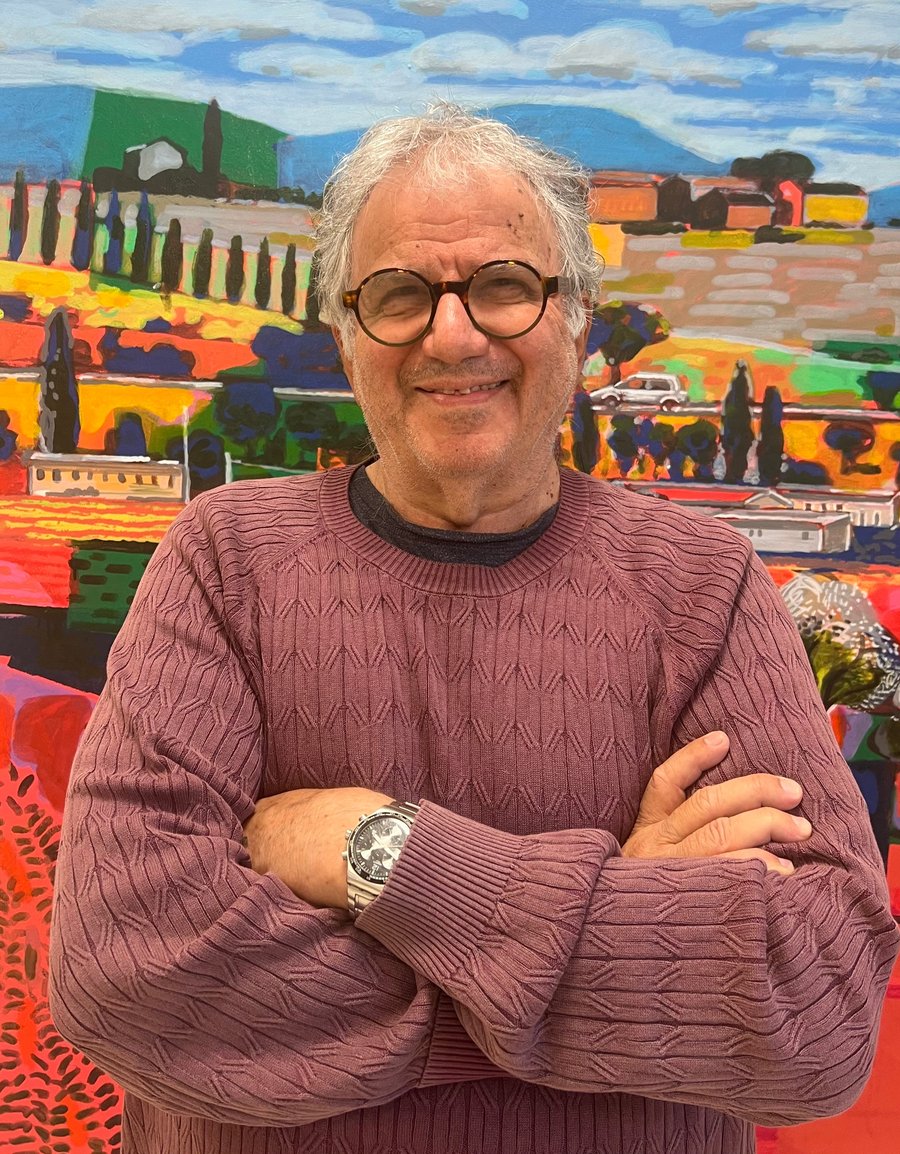
Israeli Artist | Jerusalem
Born in Jerusalem in 1944 to immigrant parents, David “Dudu” Gerstein grew up with his identical twin brother, Yoni, in a home where craft was part of daily life. His father and grandfather were leather makers, and as a boy David helped his father cut leather — hours at the workbench to which he still traces his love of cutting shapes and figures.
He studied at the Bezalel Academy in Jerusalem, the École des Beaux-Arts in Paris and the Art Students League in New York, at the height of Pop Art and Abstract Expressionism, and later completed postgraduate studies at St. Martin’s School of Art in London.
Returning to Israel in 1971, he held his first solo exhibition at the Engel Gallery in Jerusalem and taught at Bezalel until 1985. While many of his contemporaries made conceptual or political art, Gerstein chose to paint everyday life — people cycling to work, watering their flowers, watching birds from the window — in an art that speaks to people “at eye level.”
In the 1980s his palette burst into vivid colour and his paintings stepped off the wall: he cut his figures out in cardboard and wood, and later in aluminium and steel. The Israel Museum’s 1987 exhibition “From Dudu to 3-D” marked the arrival of this new language, and in the 1990s laser cutting allowed him to develop the layered, hand-painted works for which he is celebrated around the world.
Today Gerstein works from his studio in the Jerusalem hills, where four floors of painters, printers and metalworkers help bring his ideas to life under his supervision. His message remains the same: art belongs in everyday life.
Each wall sculpture begins with the artist’s design and becomes a set of precise cut-out forms in steel or aluminium, painted by hand in glossy, automotive-grade colours and mounted in layers, cut-out over cut-out. The layers stand at different depths from the wall, so every piece fills with movement and changes with the light and the angle of view. The subjects come from the life he has painted since the 1970s: cyclists racing in a peloton, crowds hurrying along Fifth Avenue, bouquets on a windowsill, clouds of butterflies and birds. Every sculpture is a signed limited edition.
The paper cuts carry the same language into a more intimate medium. Gerstein’s compositions are laser-cut in heavy paper, painted by hand and built up in layers until a flat sheet gains real depth and movement. Most are 56 × 76 cm, in signed limited editions of 100, with familiar themes — “Tour de France”, “Peloton”, “5th Avenue”, bouquets and butterflies — appearing in a new key. Because each is painted by hand, no two are exactly alike.
Gerstein has long taken his art out of the gallery and into the street. In Singapore’s business district, his “Momentum” rises 18.5 metres from 44 tonnes of steel and 175 hand-painted figures, one of the city’s tallest public sculptures. In Jerusalem his works stand at the Hebrew University on Mount Scopus, the Israel Museum and the Jerusalem Theatre; in Tel Aviv they line Dizengoff Street, and “Spirit of Freedom” stands at Tel Aviv University. Abroad they include “Roman Warrior” in Romford, Greater London, a street installation in Kassel during Documenta 2002, “Star City” in Seoul, and sculptures for the athletic stadium in Hsinchu, Taiwan — honoured in 2016 with an Artistic Creation award from Taiwan’s Ministry of Culture. His work has been exhibited in Israel, Europe, North America and Asia.
Paper Cuts · Wall Sculptures